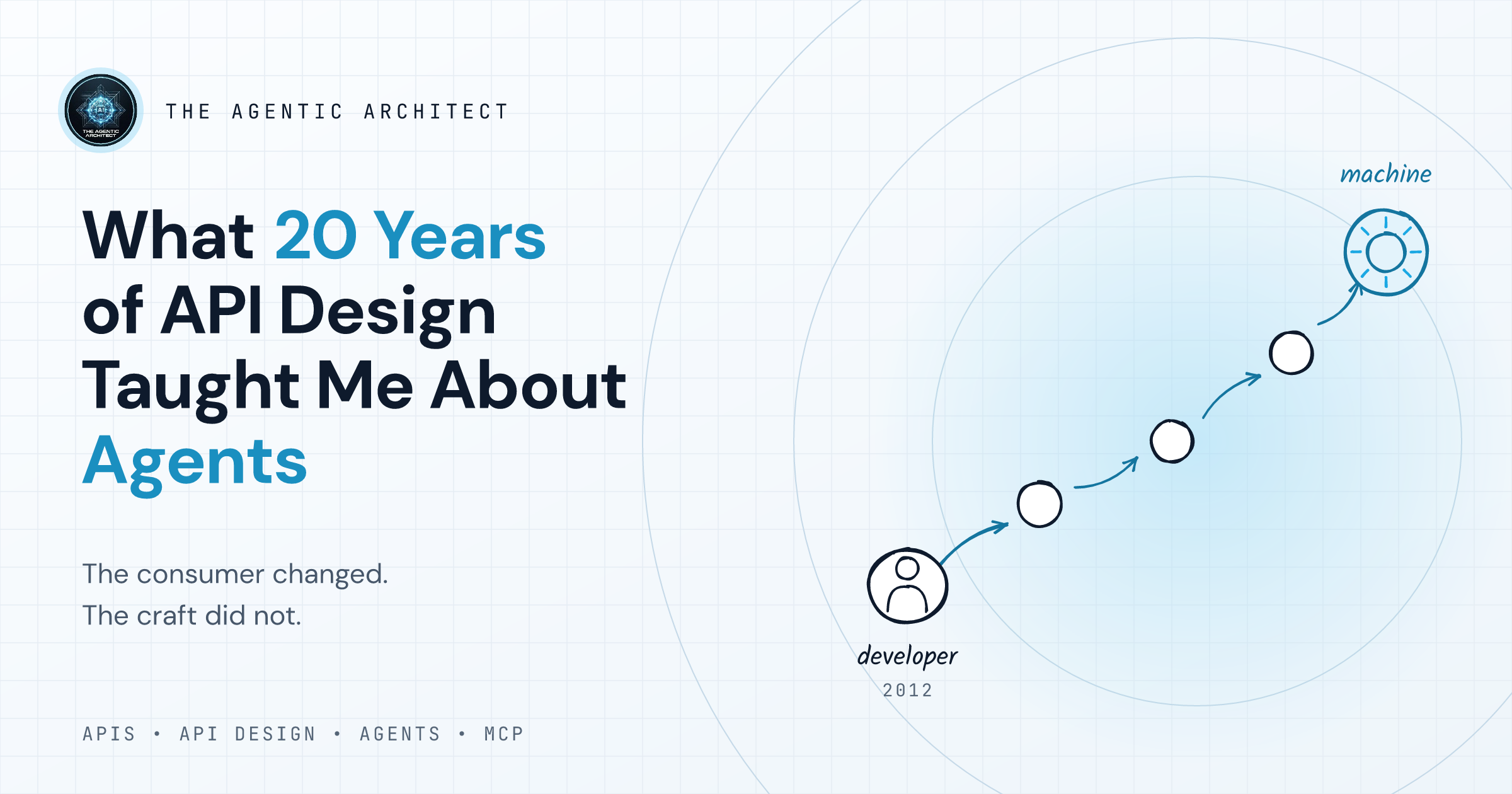
What 20 Years of API Design Taught Me About Agents — a timeline from API design to agents with the consumer changing from developer to machine

What 20 Years of API Design Taught Me About Agents

I started writing about API design in 2012. Back then the question was how to make an API good enough that a developer would pick it, learn it quickly, and keep using it. Since then the question has barely changed, but the reader has. The consumer is no longer only a developer reading documentation at a desk. Increasingly it is an agent, working from whatever it can discover and understand at runtime. ...
November 10, 2026 · 8 min · 1518 words · Hugo Guerrero
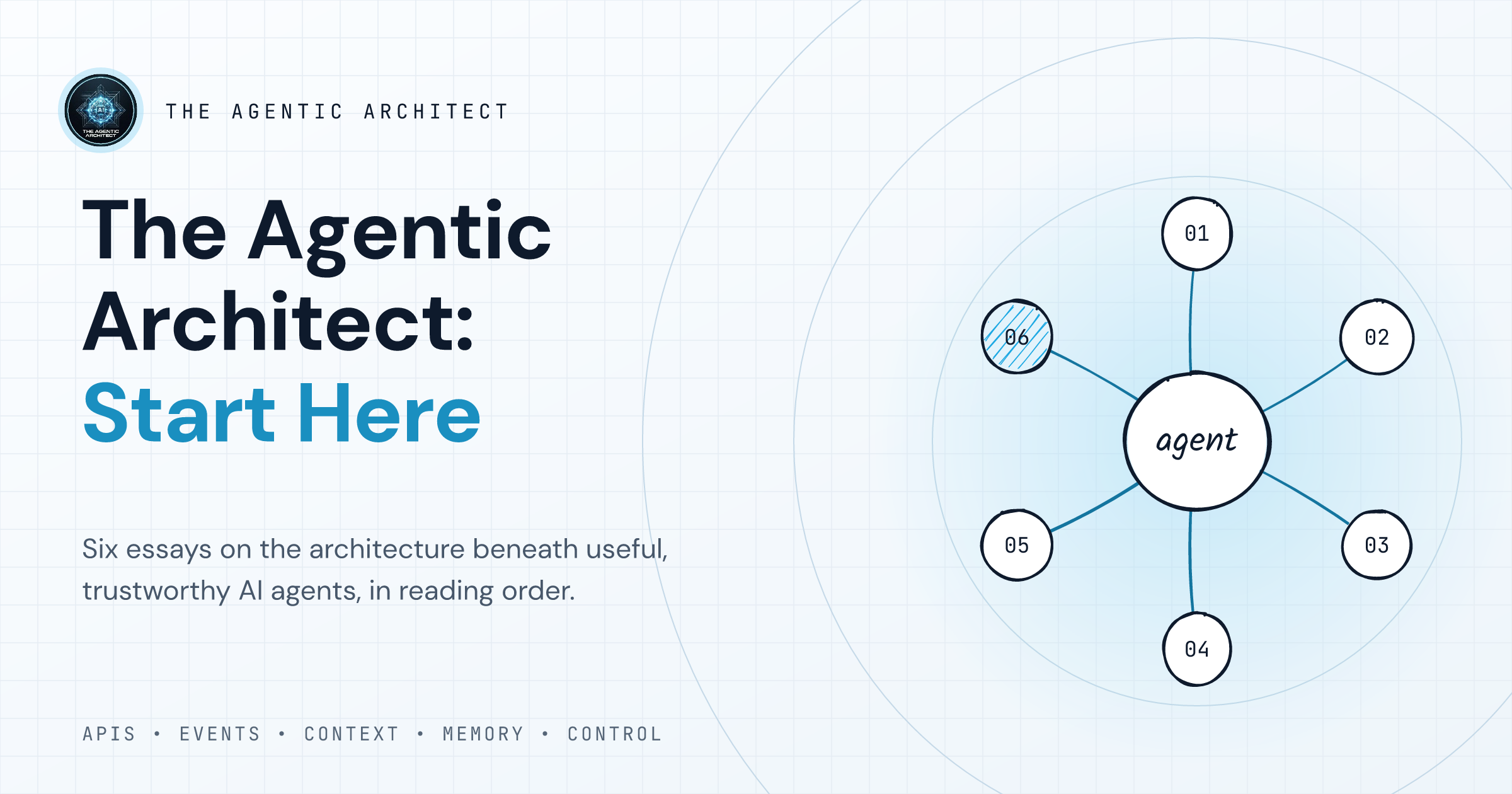
The Agentic Architect: Start Here — six numbered essays orbiting a central agent

Start Here: Six Essays on the Architecture Beneath AI Agents

Everyone is talking about agents. This site is about the architecture underneath them. If you are new here, start with these six essays. They explore the infrastructure that connects agents to the real world: APIs, events, context, memory, tools, and other agents. They are not about finding the perfect model. It was about building systems that can make a capable model useful and safe to trust. They start from a simple observation: intelligence is only one part of an agentic system. An agent also needs timely information, well-designed capabilities, clear authority, a reliable record of what happened, and controls that continue to work when the path through a task is not known in advance. ...

November 2, 2026 · 4 min · 650 words · Hugo Guerrero
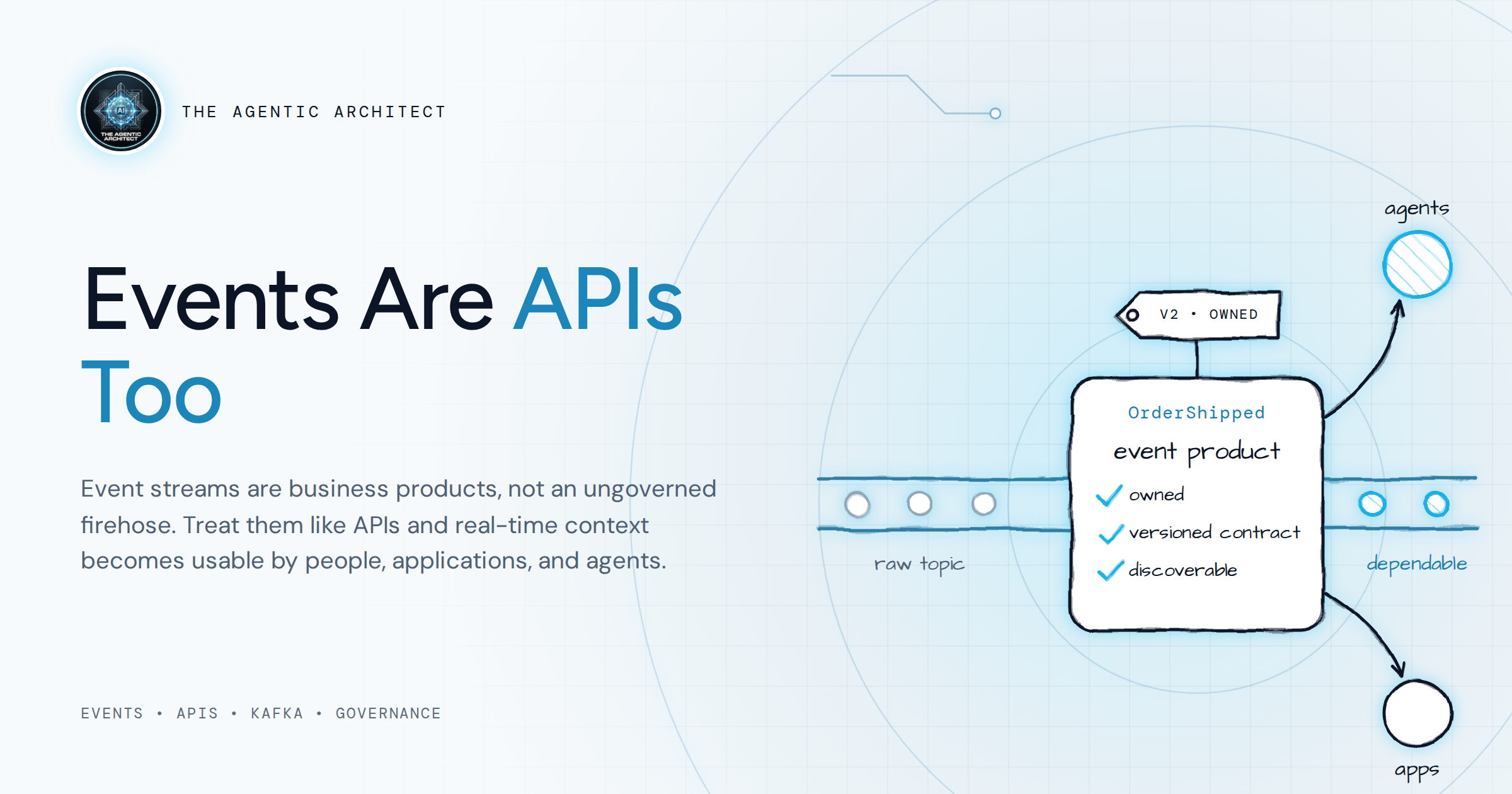
Events Are APIs Too — an OrderShipped event product, versioned and owned, flowing from a raw topic to agents and applications

Events Are APIs Too

APIs made business capabilities reusable. A well-designed API has an owner, a contract, documentation, access controls, a lifecycle, and consumers who can depend on it. Events deserve the same treatment. Too often, event streams are treated as an internal plumbing detail: a collection of topics, schemas, credentials, and conventions understood only by the team that created them. That works until the stream becomes valuable to more than one application—or to an agent that needs timely context. ...

October 27, 2026 · 5 min · 912 words · Hugo Guerrero
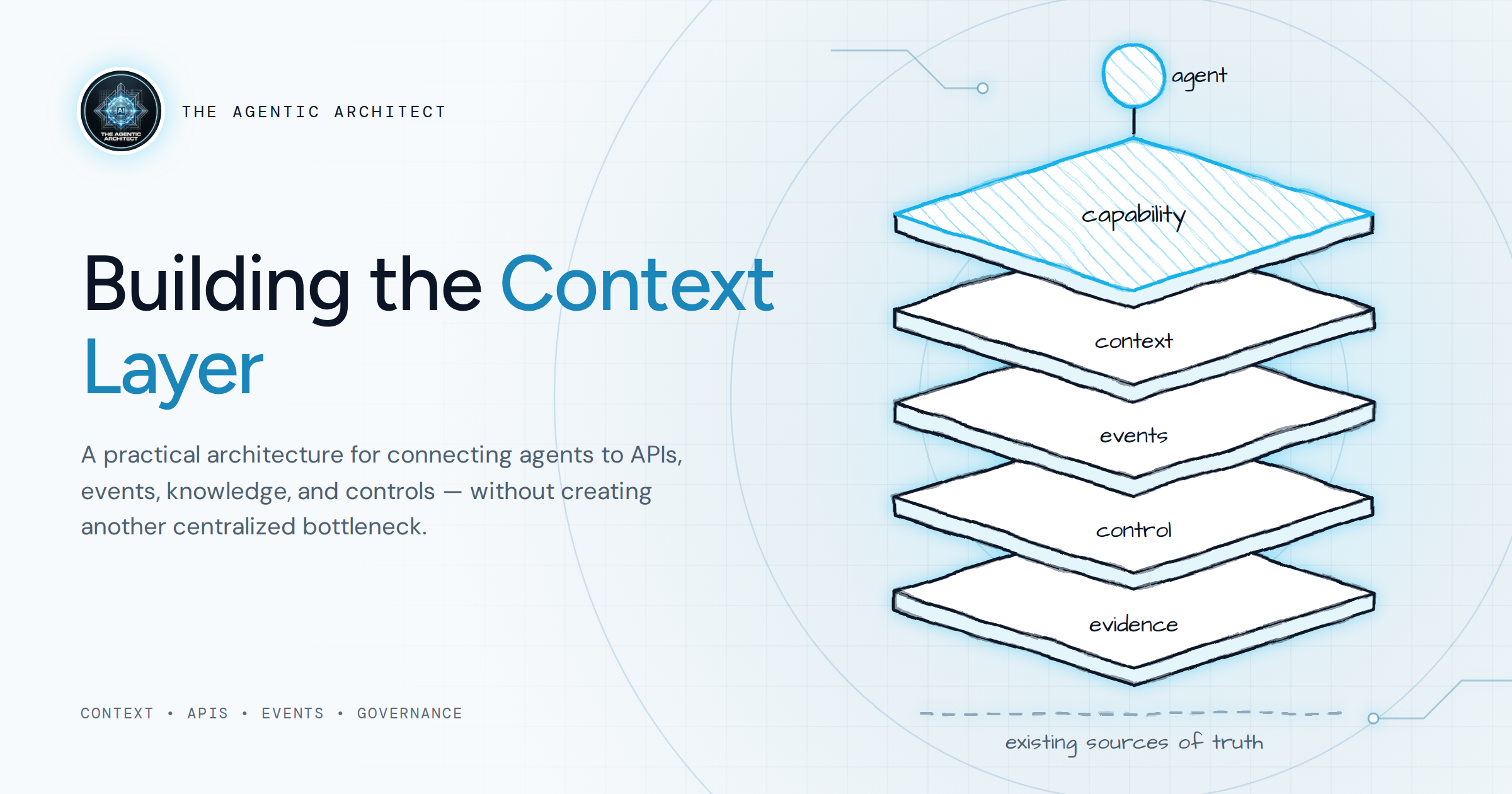
Building the Context Layer — capability, context, event, control, and evidence layers stacked beneath an agent, on top of existing sources of truth

Building the Context Layer

Once an organization accepts that agents need governed, current context, the next question is unavoidable: what do we actually build? The answer is not an all-powerful agent platform that absorbs every system. It is a set of layers that make existing capabilities usable in a new way. The goal is to preserve domain ownership while giving agents a safe, observable path to information and action. Think of the context layer as connective tissue rather than a replacement for the systems that already hold the truth. ...

October 6, 2026 · 5 min · 887 words · Hugo Guerrero
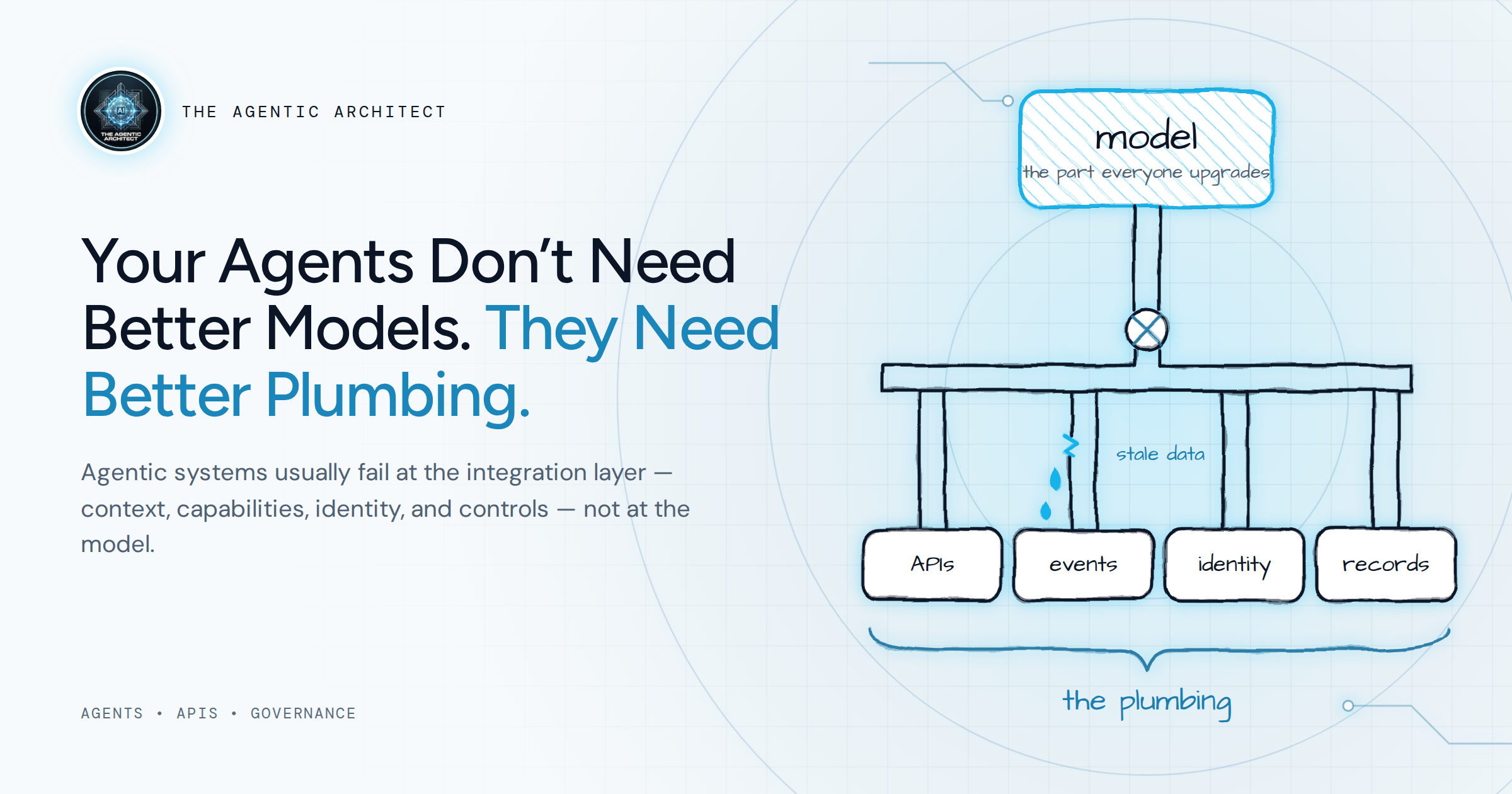
Your Agents Don’t Need Better Models. They Need Better Plumbing — a model sitting atop APIs, events, identity, and records, with stale data dripping through

Your Agents Don’t Need Better Models. They Need Better Plumbing.

There is a familiar pattern in enterprise AI projects. The team starts with a model. When the prototype disappoints, they change the prompt. Then they add retrieval. Then they try a larger model, a longer context window, or a new framework. Eventually someone asks the question that should have come first: why does the agent still fail when it leaves the demo? Often, the model is not the answer. The plumbing is. ...

September 22, 2026 · 5 min · 918 words · Hugo Guerrero
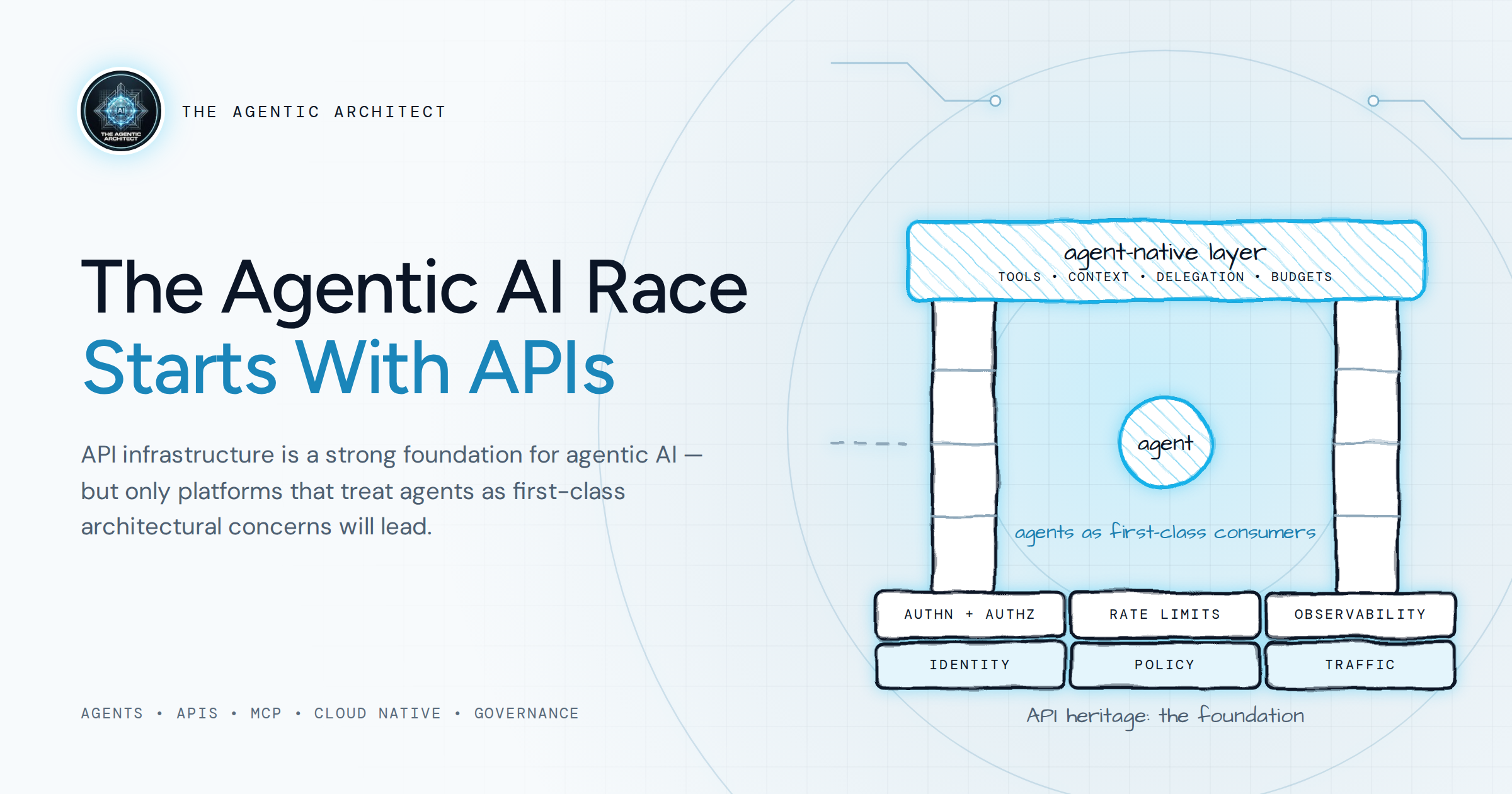
The Agentic AI Race Starts With APIs — an agent-native layer of tools, context, delegation, and budgets built on an API heritage of identity, policy, and traffic

The Agentic AI Race Starts With APIs

There is a strange debate happening in the infrastructure world right now. As enterprises begin moving from AI experiments to production agentic systems, everyone wants to own the layer between agents, models, tools, data, and applications. Data platforms want to own it. Cloud providers want to own it. AI infrastructure vendors want to own it. And, increasingly, API infrastructure vendors are showing up with a surprisingly strong claim: We have already been here. ...

September 20, 2026 · 10 min · 2068 words · Hugo Guerrero
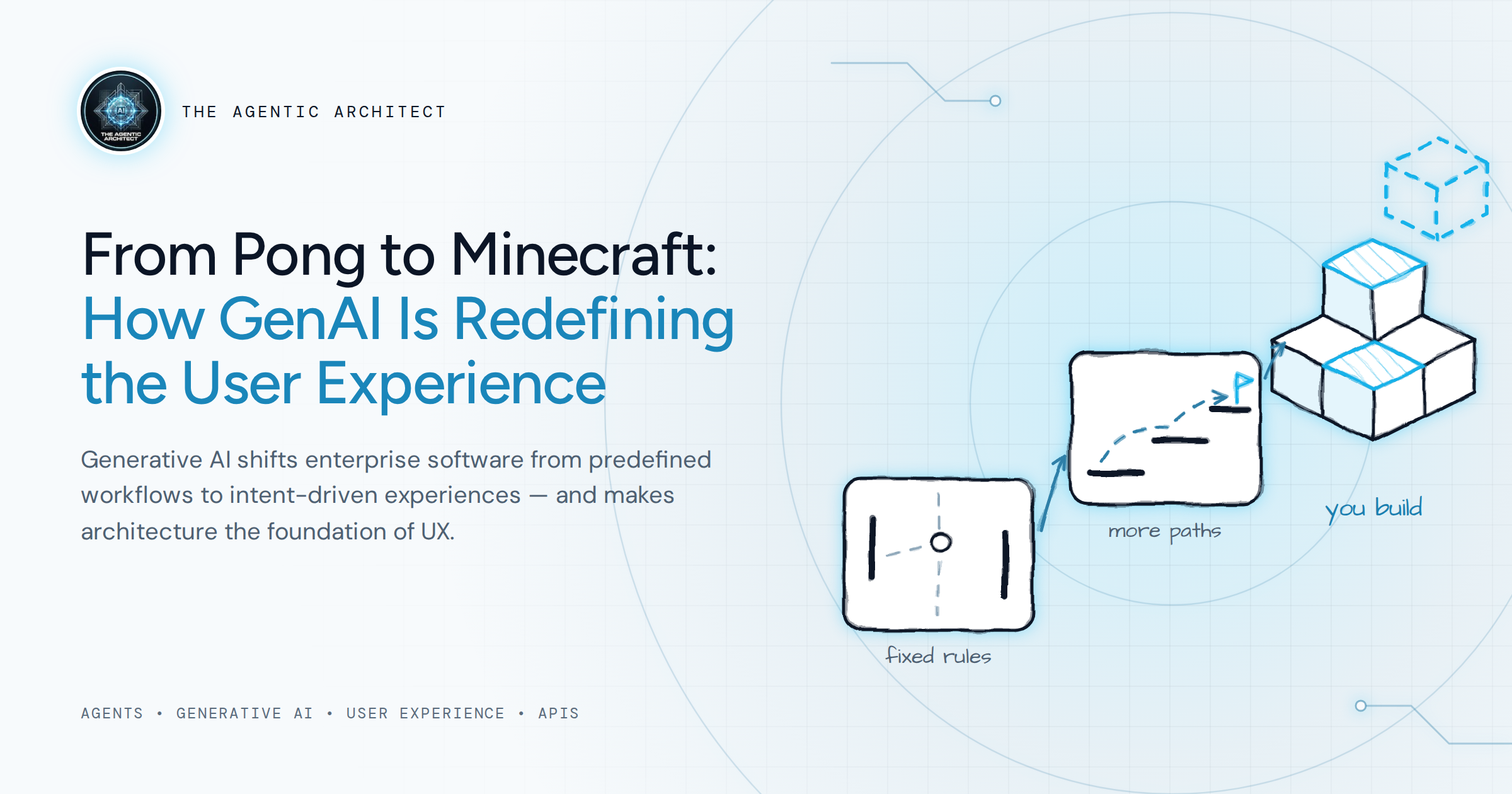
From Pong to Minecraft: How GenAI Is Redefining the User Experience — fixed rules evolving into more paths, then into blocks you build

From Pong to Minecraft: How GenAI Is Redefining the User Experience

For decades, enterprise software has worked roughly the same way. You find the application. You find the right screen. You follow the workflow. You fill in the fields. You click the button. The software tells you what you can do, and you adapt yourself to it. For a long time, that was enough. But we are entering a very different era. If enterprise software was Pong, and modern applications evolved into something closer to Mario Bros, then generative AI is taking us into the Minecraft generation. ...

August 20, 2026 · 8 min · 1579 words · Hugo Guerrero

Welcome to The Agentic Architect

The agentic era will not be won by the teams with the cleverest prompt. It will be won by organizations whose systems expose trustworthy, discoverable capabilities that agents can safely use. That is the premise of The Agentic Architect: architecture patterns for agentic systems people can trust. Models matter. But a capable model without the right context, tools, identity, and controls is still a limited agent. The hard—and interesting—work is building the architecture around intelligence so that it can understand an objective, act responsibly, and earn trust. ...

August 19, 2026 · 2 min · 395 words · Hugo Guerrero