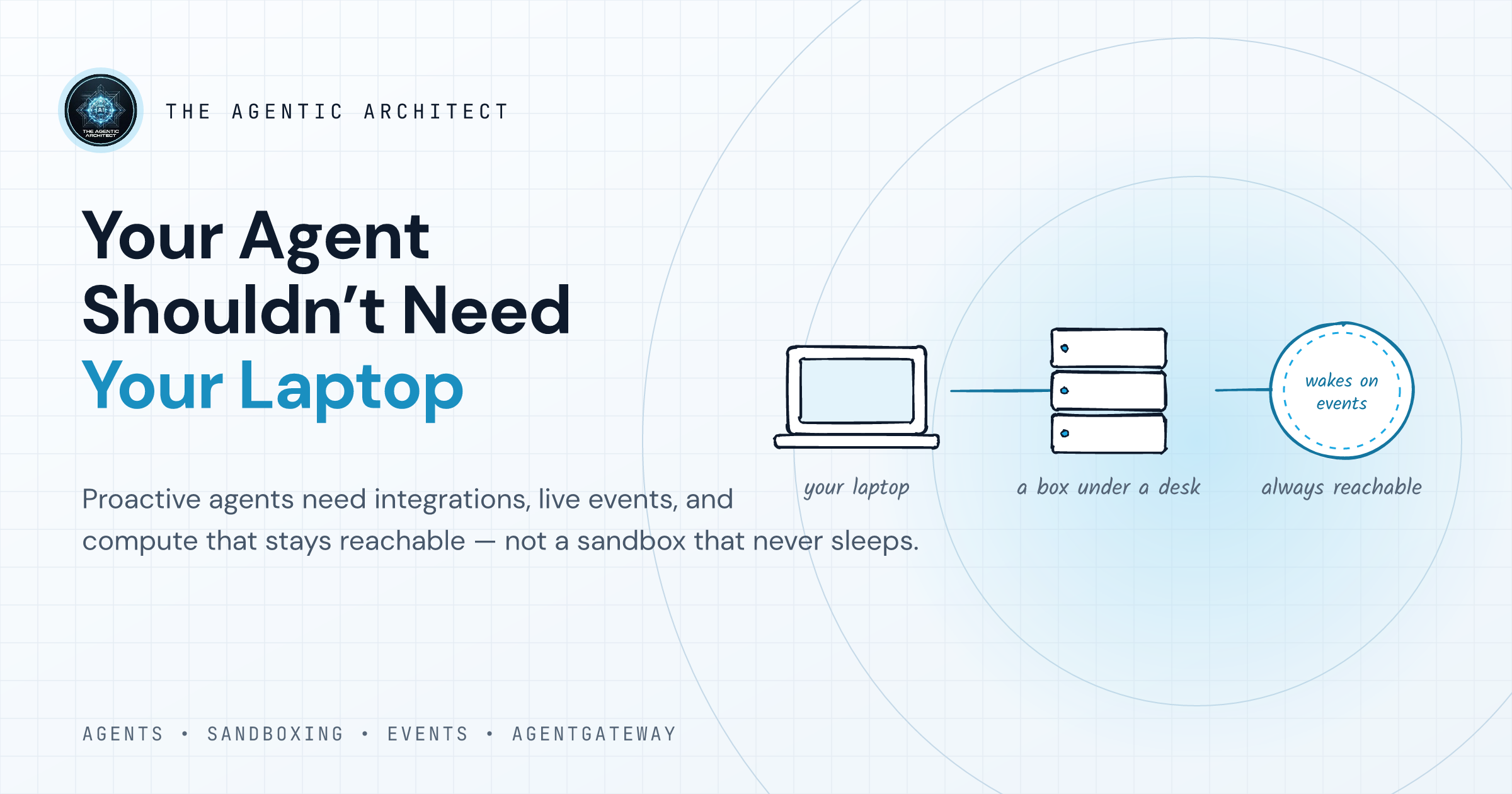
Your Agent Shouldn't Need Your Laptop: an agent moving from a laptop, to a Mac mini under a desk, to a sandbox on shared infrastructure that wakes on events

Your Agent Shouldn't Need Your Laptop

Most of us met AI agents as something we open. You type, the agent works, you close the tab, and the agent stops existing. That is fine for a coding session or a quick question. It does not work for what people actually want from an assistant: something that notices the contract that came in overnight, sees that CI failed after you left, and has a draft response ready before you ask. ...
November 5, 2026 · 9 min · 1835 words · Hugo Guerrero
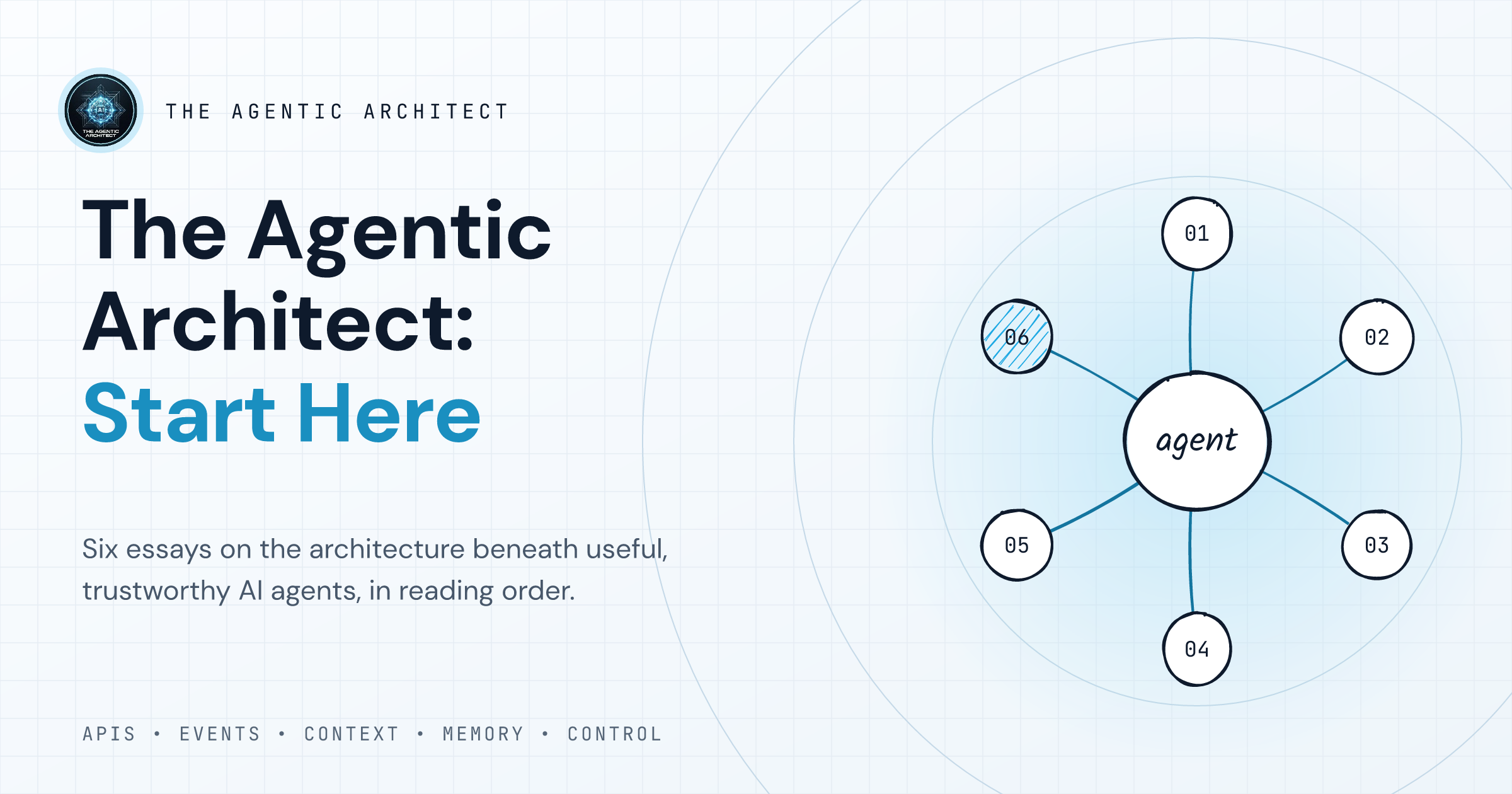
The Agentic Architect: Start Here — six numbered essays orbiting a central agent

Start Here: Six Essays on the Architecture Beneath AI Agents

Everyone is talking about agents. This site is about the architecture underneath them. If you are new here, start with these six essays. They explore the infrastructure that connects agents to the real world: APIs, events, context, memory, tools, and other agents. They are not about finding the perfect model. It was about building systems that can make a capable model useful and safe to trust. They start from a simple observation: intelligence is only one part of an agentic system. An agent also needs timely information, well-designed capabilities, clear authority, a reliable record of what happened, and controls that continue to work when the path through a task is not known in advance. ...

November 2, 2026 · 4 min · 650 words · Hugo Guerrero
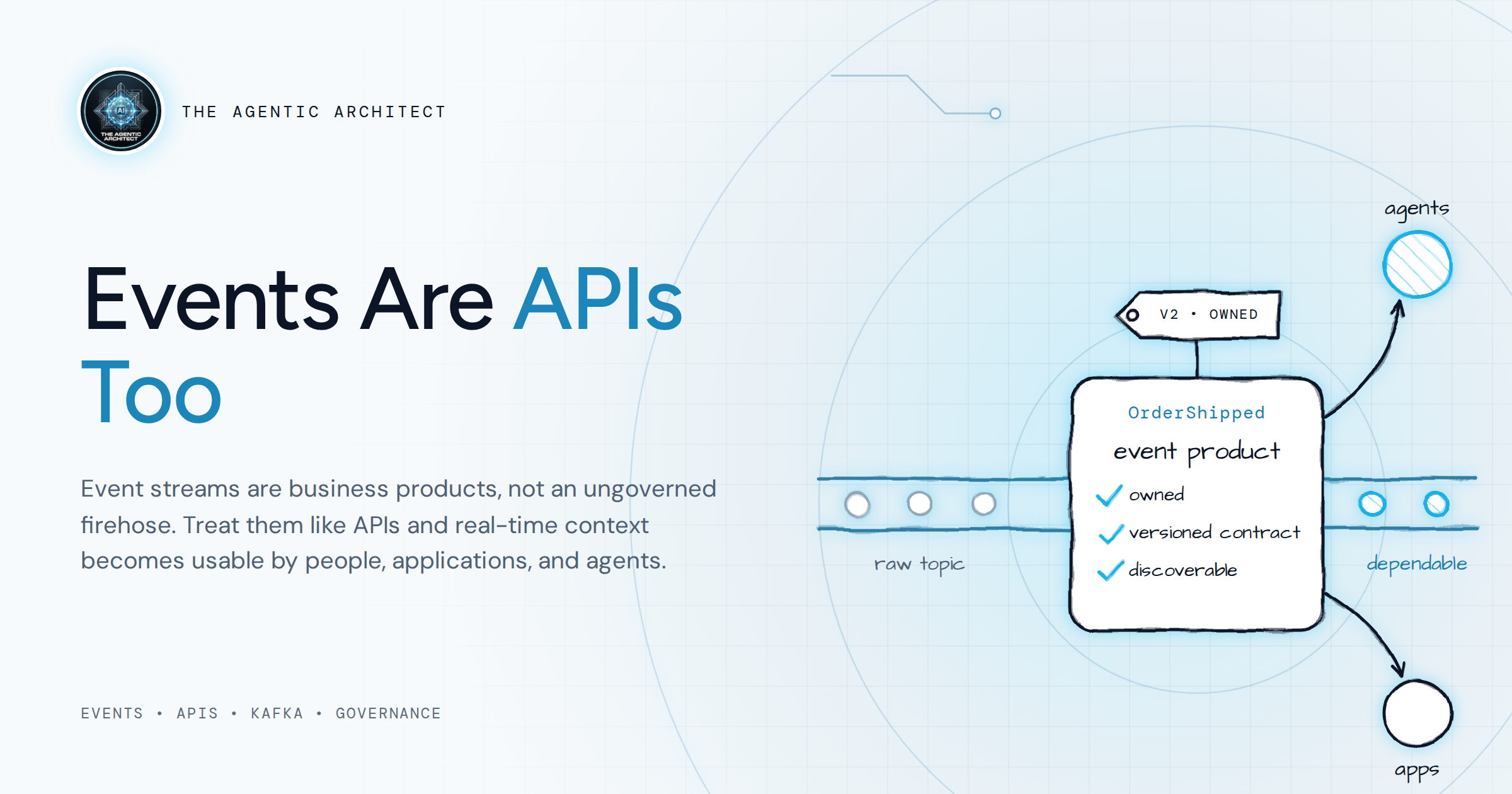
Events Are APIs Too — an OrderShipped event product, versioned and owned, flowing from a raw topic to agents and applications

Events Are APIs Too

APIs made business capabilities reusable. A well-designed API has an owner, a contract, documentation, access controls, a lifecycle, and consumers who can depend on it. Events deserve the same treatment. Too often, event streams are treated as an internal plumbing detail: a collection of topics, schemas, credentials, and conventions understood only by the team that created them. That works until the stream becomes valuable to more than one application—or to an agent that needs timely context. ...

October 27, 2026 · 5 min · 912 words · Hugo Guerrero
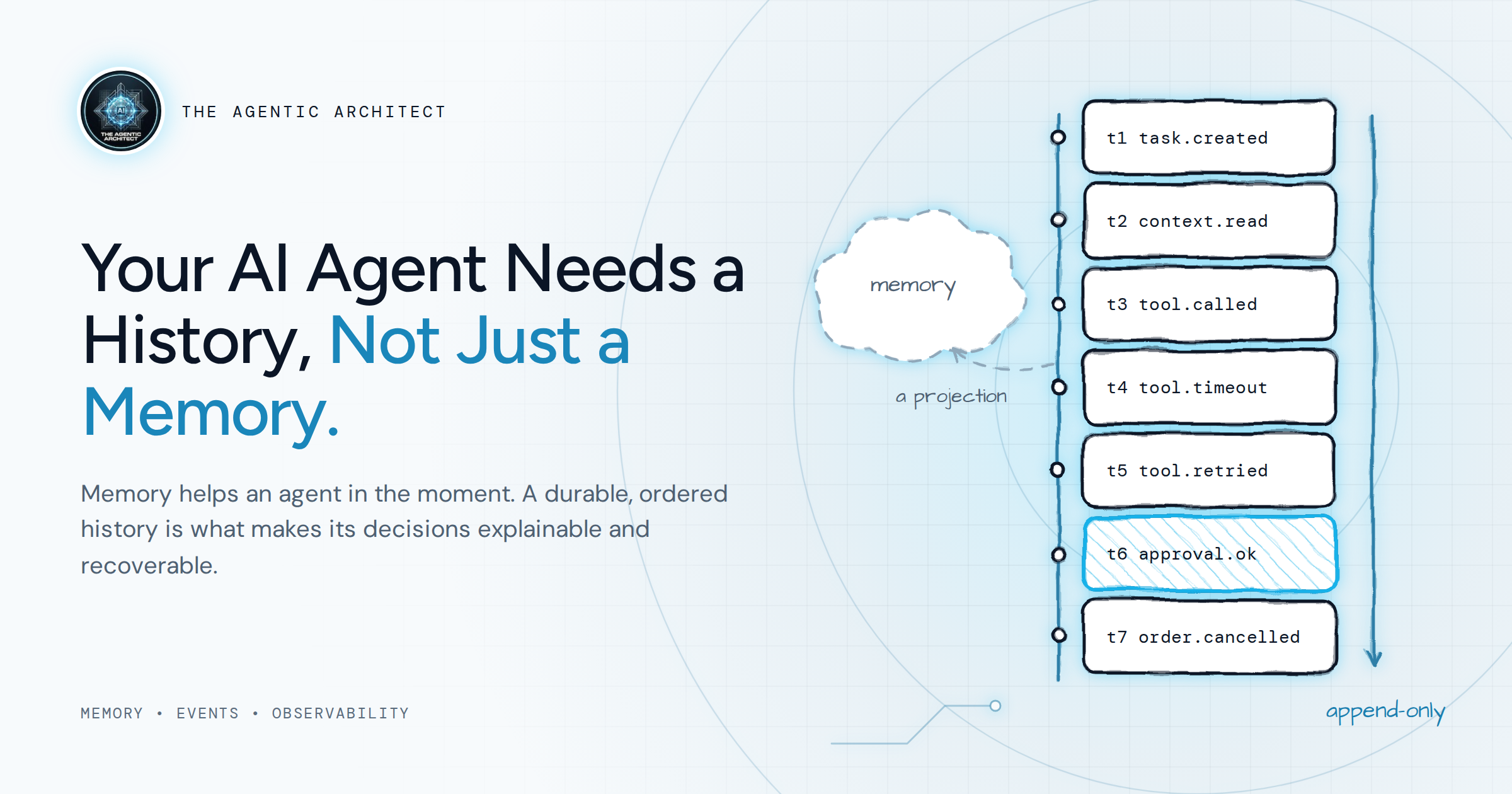
Your AI Agent Needs a History, Not Just a Memory — an append-only ordered log of task events beside a memory cloud that projects from it

Your AI Agent Needs a History, Not Just a Memory.

When an agent gets something wrong, teams often inspect its final answer and the context retrieved for the last model call. That can explain what the agent believed at the end. It rarely explains how it got there. For consequential systems, that distinction matters. An agent needs memory: relevant knowledge from past interactions, retrieved documents, and working state for the task at hand. But memory is not history. Memory answers, “What should I recall now?” History answers, “What happened, in what order, and why did the system reach this state?” ...

October 20, 2026 · 5 min · 922 words · Hugo Guerrero
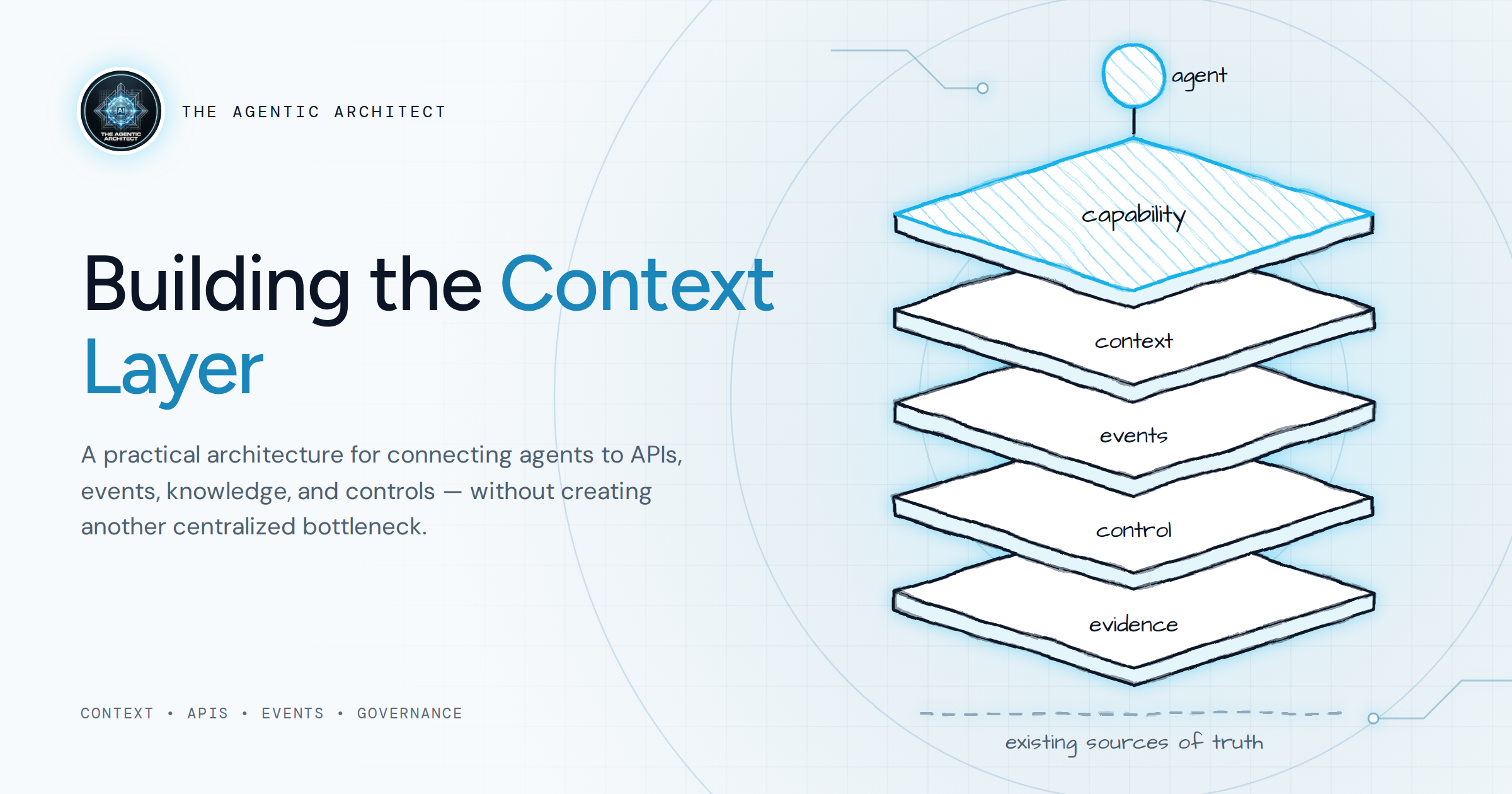
Building the Context Layer — capability, context, event, control, and evidence layers stacked beneath an agent, on top of existing sources of truth

Building the Context Layer

Once an organization accepts that agents need governed, current context, the next question is unavoidable: what do we actually build? The answer is not an all-powerful agent platform that absorbs every system. It is a set of layers that make existing capabilities usable in a new way. The goal is to preserve domain ownership while giving agents a safe, observable path to information and action. Think of the context layer as connective tissue rather than a replacement for the systems that already hold the truth. ...

October 6, 2026 · 5 min · 887 words · Hugo Guerrero